


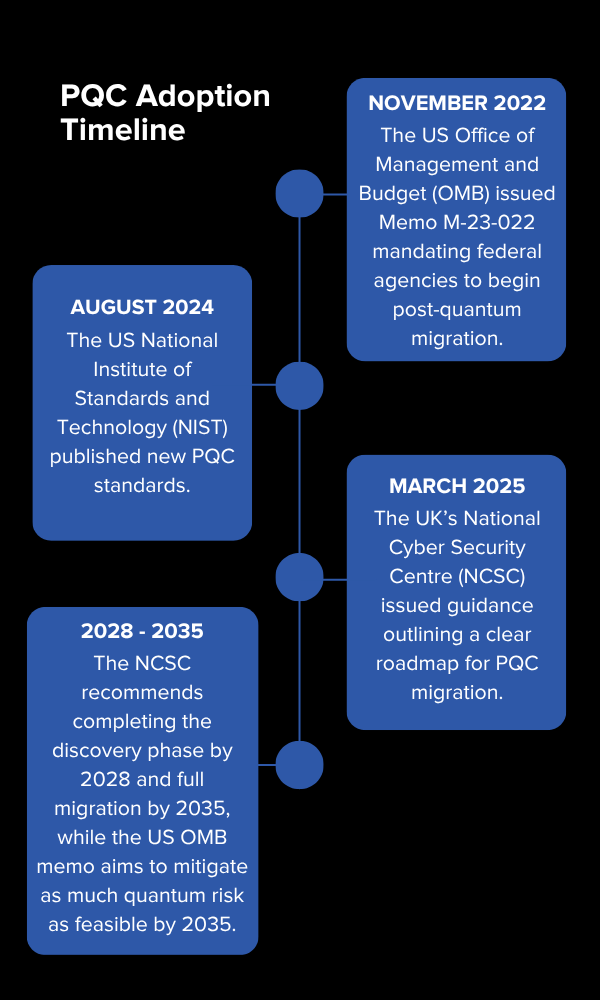
The advent of quantum computing threatens to render today’s encryption obsolete, putting global data security at risk. Post-quantum cryptography (PQC) – a new class of quantum-resistant algorithms – is emerging as a leading defence. In response, national cybersecurity authorities around the world are now driving the shift.
While the exact timeline remains uncertain, the NCSC recommends completing the discovery phase by 2028 and full migration by 2035¹, while the US Office of Management and Budget (OMB) Memo M-23-02 sets a goal of mitigating as much quantum risk as feasible by 2035², industry and government guidance agree that preparations for transition to PQC must begin now.
Randomness is critical for all cryptographic protocols
Randomness is one of the foundational parts of any cryptographic system, forming the basis of encryption keys that secure sensitive data. Every encryption protocol – from the simplest cipher used by the Romans to the most advanced PQC algorithm – relies on the strength of its encryption keys. Higher quality randomness creates stronger encryption keys.
While PQC algorithms are designed to withstand attacks from quantum computers, they are not a complete solution. Like all cryptographic systems, they rely on a critical input: randomness. Most current PQC implementations still use classical random number generators, which may not provide sufficient entropy for long-term, quantum- resilient security.
Quantum computers are expected to amplify existing RNG weaknesses
Quantum computers are expected to amplify existing weaknesses in classical random number generators – issues already seen in real-world cases like the 2008 OpenSSL flaw⁴ and Cisco’s ASA firewall vulnerability in 2019 and again in 2023⁵, all caused by insufficient randomness.
These examples show how poor entropy can undermine security even without quantum threats. A whitepaper published by the Alliance for Telecommunications Industry Solutions (ATIS) highlights that cryptographic strength relies on entropy quality as much as key length – without high quality entropy, even 256-bit AES keys remain vulnerable to quantum attacks like Grover’s.⁶
PQC places greater demands on randomness sources
With PQC, the demands on the quality and reliability of randomness sources are even greater:
- Higher volume: Many PQC protocols require 100 to 1,000 times more random numbers than classical algorithms.⁷
- Specific distributions: PQC algorithms can also require different statistical distribution for these random numbers.
- Long-term resilience: Cryptographic keys must resist quantum attacks over an extended period, making entropy quality even more critical.
References:
- https://www.nist.gov/news-events/news/2024/08/nist-releases-first-3-finalized-post-quantum-encryption-standards
- https://www.whitehouse.gov/wp-content/uploads/2022/11/M-23-02-M-Memo-on-Migrating-to-Post-Quantum-Cryptography.pdf
- https://www.ncsc.gov.uk/guidance/pqc-migration-timelines
- https://www.csis.org/analysis/moving-toward-all-above-approach-quantum-cybersecurity
- https://nvd.nist.gov/vuln/detail/cve-2023-20107
- https://atis.org/wp-content/uploads/2023/02/Quantum-Entropy-Report-v6-1.pdf
- ‘A Guide to a Quantum-Safe Organization’, QED-C
In the next blog, we’ll explore how self-certifying QRNGs can benefit PQC adoption.
In the meantime, if you would like to learn how Quantum Dice's verifiable source of randomness can support PQC, speak to our team.